
A nursing reflective essay examines more than what happened: it explores your decisions, feelings, the evidence that informed your response, and what you learned. A clear reflection connects a clinical experience to your development as a nurse.
To get started, choose a suitable framework and organize the experience around its prompts, while giving analysis more space than retelling. Follow your assignment brief and local confidentiality rules; next, begin by defining the experience you’ll reflect on.
Key Takeaways
- Follow the framework your assignment requires; Gibbs offers six stages for reflecting on a single clinical event, from description to action planning.
- Keep the event summary brief, then analyze why you acted as you did, what shaped the outcome, and what you might change.
- Support your analysis and proposed actions with current nursing evidence, relevant professional standards, and your course’s required citation style.
- Remove details that could identify patients, colleagues, or clinical settings. Follow your school’s rules and consult the NMC’s written reflection guidance as a professional reference.
- End with a clear lesson and a specific, practical step you can apply in future nursing practice.
How to write a reflective essay nursing students can use to show their learning
A strong nursing reflective essay connects one clinical experience to your decisions, learning, and future practice. First, check your assignment brief for the required framework, headings, word count, and citation style, since these vary by course.
Choose one focused clinical experience
Select a specific event with a clear decision, challenge, or learning point. It might involve communication with a patient, teamwork during a busy shift, a safety concern, or an ethical question. Choose an experience you can analyze, not just retell.
Keep the account brief and protect privacy. Remove names, exact dates, locations, and details that could identify a patient or colleague. For example, you could describe a communication difficulty without including a distinctive diagnosis or setting.
Build the essay from introduction to action plan
Use the format your instructor requires. If the assignment allows a conventional essay structure, move through these steps:
- Introduce the focus. State the purpose of the reflection, identify the framework you’ll use, and give minimal context.
- Describe the event. Explain what happened and your response, keeping the narrative concise.
- Analyze the experience. Examine what shaped your decisions, what went well or poorly, and what evidence or professional guidance helps explain the outcome.
- Identify your learning. State what you understand now and what you might do differently.
- Conclude with an action. Name a practical next step, such as reviewing a relevant procedure or asking for supervised practice.
Gibbs’ cycle offers six stages: description, feelings, evaluation, analysis, conclusion, and action plan. The University Hospitals Bristol reflective writing guide outlines prompts for working through them. You can use the stages as headings if your assignment permits, or weave them into standard essay paragraphs. Keep the analysis and action plan focused on what you learned and how you’ll apply it.

Use a reflection model to organize your nursing essay
A reflection model can guide your essay, but it should support your thinking rather than become a checklist. Follow the framework required by your course, and use its prompts to examine your choices, the context, and what you’ll change in future practice.
Apply Gibbs’ Reflective Cycle to one event
Gibbs’ Reflective Cycle offers six stages for examining a single clinical event. The University of Cumbria’s Gibbs cycle guide explains the stages and shows how they can shape a written reflection.
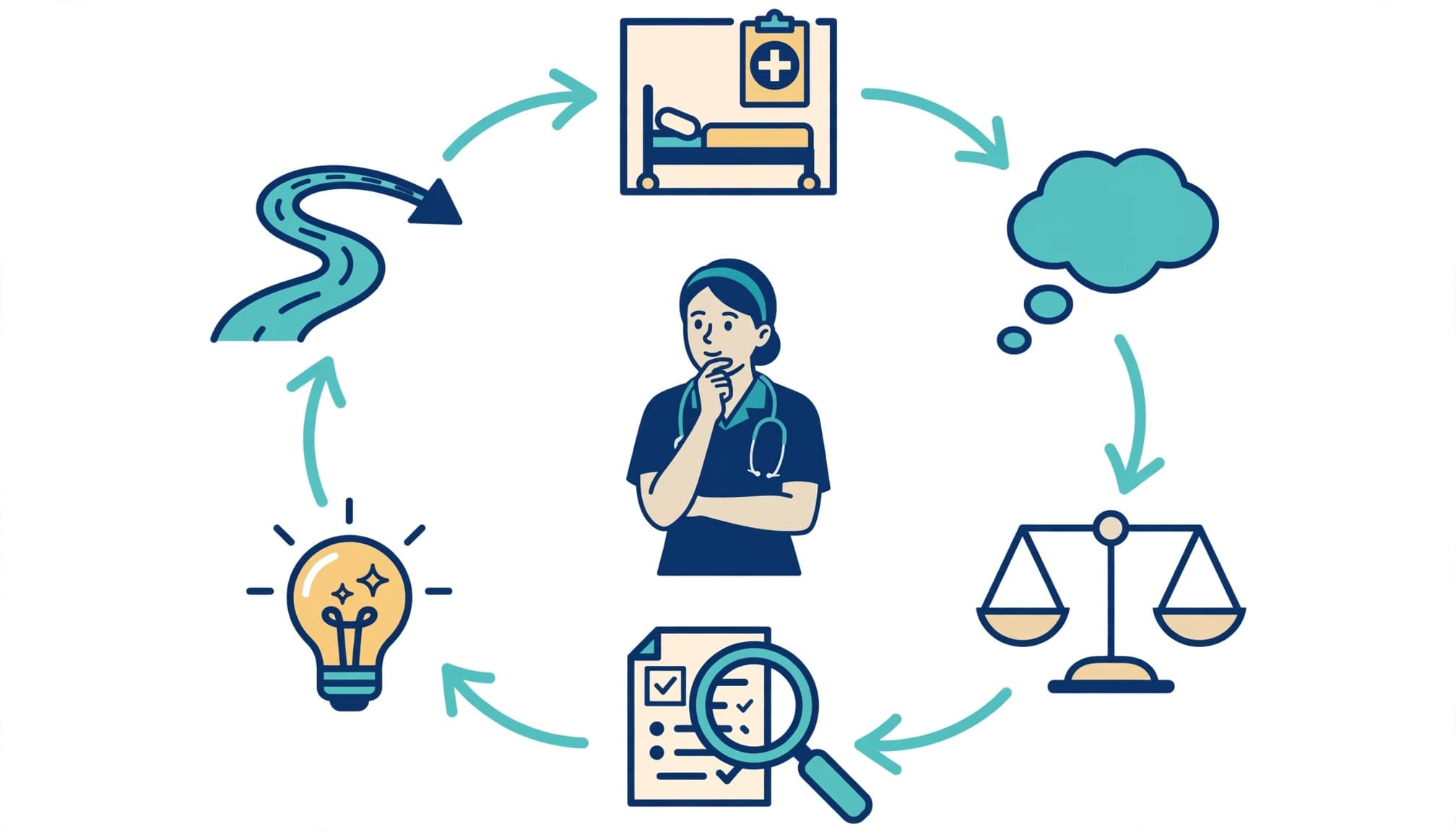
Start with a concise description of what happened, then consider your feelings at the time and afterward. In the evaluation stage, identify what went well and what did not. Next, use analysis to explain why the event unfolded as it did, drawing on relevant nursing knowledge or evidence.
The conclusion states what you learned and what you could have done differently. Finally, your action plan names a practical step for a similar situation, such as reviewing a relevant procedure or seeking supervised practice. Spend more space analyzing and applying the lesson than retelling the event.
Choose another framework only when it fits the assignment
Johns’ and Driscoll’s models are possible alternatives, but their prompts and versions can vary. Check your course materials before applying one, and cite the version your instructor assigns. No single framework is required for every nursing essay.
Whichever model you use, treat its stages as prompts for critical thought, not boxes to tick. Your reflection should explain how the experience shaped your understanding and what specific action you’ll take next.
Make your reflection critical, evidence-based, and professional
A strong nursing reflection moves beyond a timeline of events. Examine why you made each choice, what shaped the outcome, and how nursing evidence or professional standards inform what you would do next.

Explain why the event unfolded as it did
After briefly describing the event, analyze what went well and what made the situation difficult. Consider how your knowledge, assumptions, communication, workload, and available support influenced your decisions. Then identify realistic alternatives and explain why you did or didn’t choose them.
Separate what you understood at the time from what you learned afterward. That distinction helps you avoid judging your earlier response with information you didn’t have. Connect the experience to relevant nursing knowledge or standards, then use that learning to name a specific action for a similar situation, such as reviewing a procedure or asking for supervised practice.
Use sources to support your analysis and next steps
Use current, relevant research or professional guidance to support claims about appropriate practice and explain your proposed action. For example, if you conclude that you need to improve a clinical skill, identify evidence that supports the learning step you plan to take. Cite the reflective framework and any standards or studies you discuss.
Follow your school’s required citation style and source rules. The NMC reflective practice guidance offers a professional reference, but your program’s requirements and applicable local standards take priority.
Protect privacy and check the final draft
Remove names and details that could identify patients, colleagues, or others. A pseudonym alone may not protect someone if the setting, timing, or circumstances still make them recognizable. The NMC guidance on reflective accounts states that written accounts must not include information that could identify an individual.
Before submitting, check that your reflection stays focused, covers the required framework, supports its analysis with evidence, and ends with a practical action. Then proofread for grammar and confirm that you’ve followed the assignment brief.